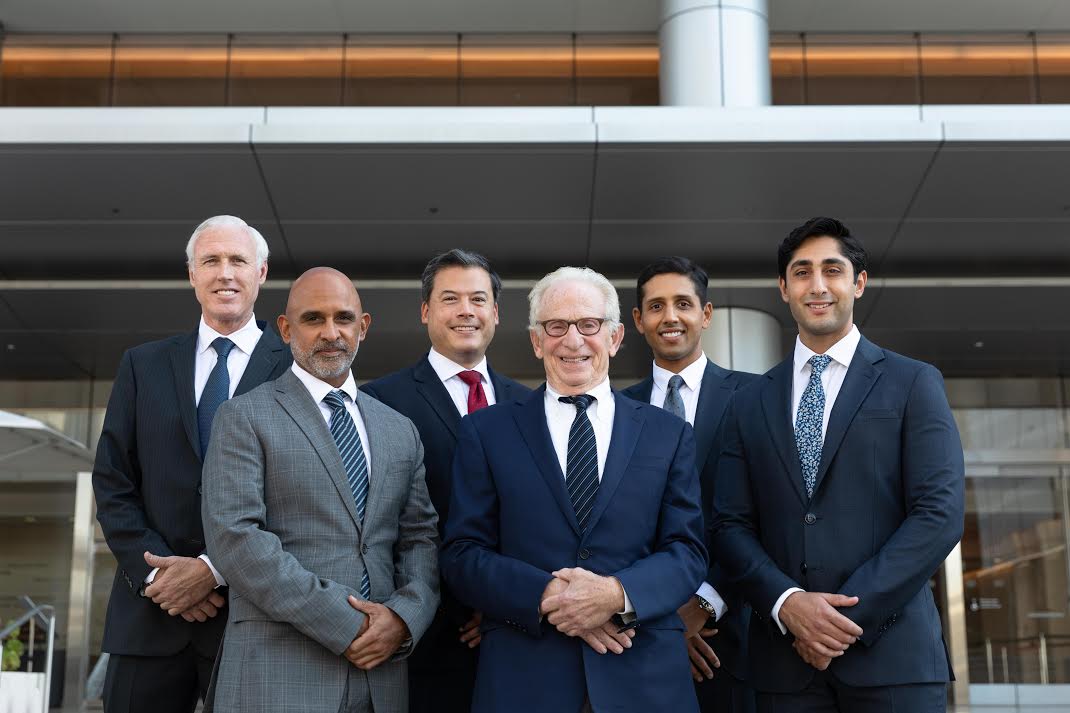
In 1961 Doctors Richard Treiman and Robert Foran
completed their general surgical training at
the Los Angeles County/University of Southern
California (LAC/USC) Medical Center. Dr. Foran
traveled north to the University of Oregon where
he completed a fellowship in cardiac and vascular
surgery. He then joined the faculty under the
chairmanship of Dr. J. Engelbert Dunphy, one
of the most renowned surgical pioneers of his
time. Concurrently, Dr. Treiman remained at
the University of Southern California for an
additional year as the Supervisor of Residents
before beginning a one-year vascular surgical
fellowship under Drs. Michael DeBakey and Denton
Cooley.
After his training at Baylor University in
1963, Dr. Treiman persuaded Dr. Foran to leave
his academic position at the University of Oregon
to establish one of the first practices in Southern
California devoted exclusively to vascular surgery.
In 1971, Dr. Phillip Levin became the newest
member of Vascular Surgery Associates (VSA)
following his training at UCLA. Dr. Louis Cohen,
who had entered practice in the same community
several years earlier, joined VSA in 1975. The
first East Coast product, Dr. David Cossman
arrived from Tufts in 1977, coinciding with
the opening of the new Cedars-Sinai Medical
Center. After general surgery training at USC
and a vascular fellowship at the University
of North Carolina, Dr. Willis Wagner returned
to Los Angeles in 1988 as the newest member
of the practice. Dr. Rajeev Rao joined the practice
in 2004 after general surgery training at the
University of Miami and a vascular fellowship
at the University of Southern California. Finally,
Dr. Edward Li joined in 2009 after having completed
general surgery at the University of Maryland,
a trauma/critical care fellowship at Shock Trauma
in Baltimore, and a vascular surgery fellowship
at Emory University in Atlanta.
Since its inception, members of VSA have been
at the forefront of vascular surgery in Southern
California. In 1964, Drs. Treiman and Foran
implanted the first permanent dialysis access
in Los Angeles, a Scribner shunt. Two years
later the same surgeons performed the first
kidney transplant in the city, at Children’s
Hospital. The kidney transplant program expanded
significantly under the direction of Dr. Louis
Cohen, the surgical director of the program
at Cedars-Sinai. Between 1971 and 1984, the
members of Vascular Surgery Associates trained
many outstanding surgeons in its vascular surgical
fellowship program. Dr. Cossman brought an expertise
in noninvasive vascular technology to the practice.
In 1984, he established the vascular diagnostic
service at Cedars-Sinai, which is currently
one of the highest volume programs in the United
States. During the mid-1980s the members of
VSA were among the first in the country to perform
carotid artery surgery based on ultrasound images
alone and to use color-flow imaging to map the
arterial anatomy of the lower extremities. Dr.
Levin, a leader in treatment of venous disease,
was an early proponent of minimally invasive
venous techniques, most recently radiofrequency
ablation of the saphenous vein.
The surgeons of VSA have been proponents of
minimally invasive vascular surgical techniques
since they were first developed. These techniques,
also known as endovascular therapy, were developed
over the past 20 years and offer patients the
potential of having their specific condition
treated without the need for a large surgical
incision, or any incision at all. A broad spectrum
of endovascular procedures is provided by the
surgeons of VSA. These include endovascular
abdominal aortic aneurysm repair, descending
thoracic aortic aneurysm or symptomatic dissection
repair, carotid artery stenting, lower extremity
angioplasty and stenting, inferior vena cava
filter placement, renal artery stenting, and
dialysis access thrombectomy and intervention.
Drs. Wagner and Cossman began treating abdominal
aortic aneurysms with the Ancure ELG system
(Guidant Corp., Indianapolis, IN). As endovascular
technology improved, VSA surgeons continued
to implement the latest developments to best
treat patients. Drs. Rao and Li were brought
into the group to continue this VSA tradition
of adopting the latest and best techniques to
treat what was once difficult or impossible.